**Please note that this page may contain affiliate links. As an Amazon Associate, I earn from qualifying purchases. This is at no extra cost to you.**

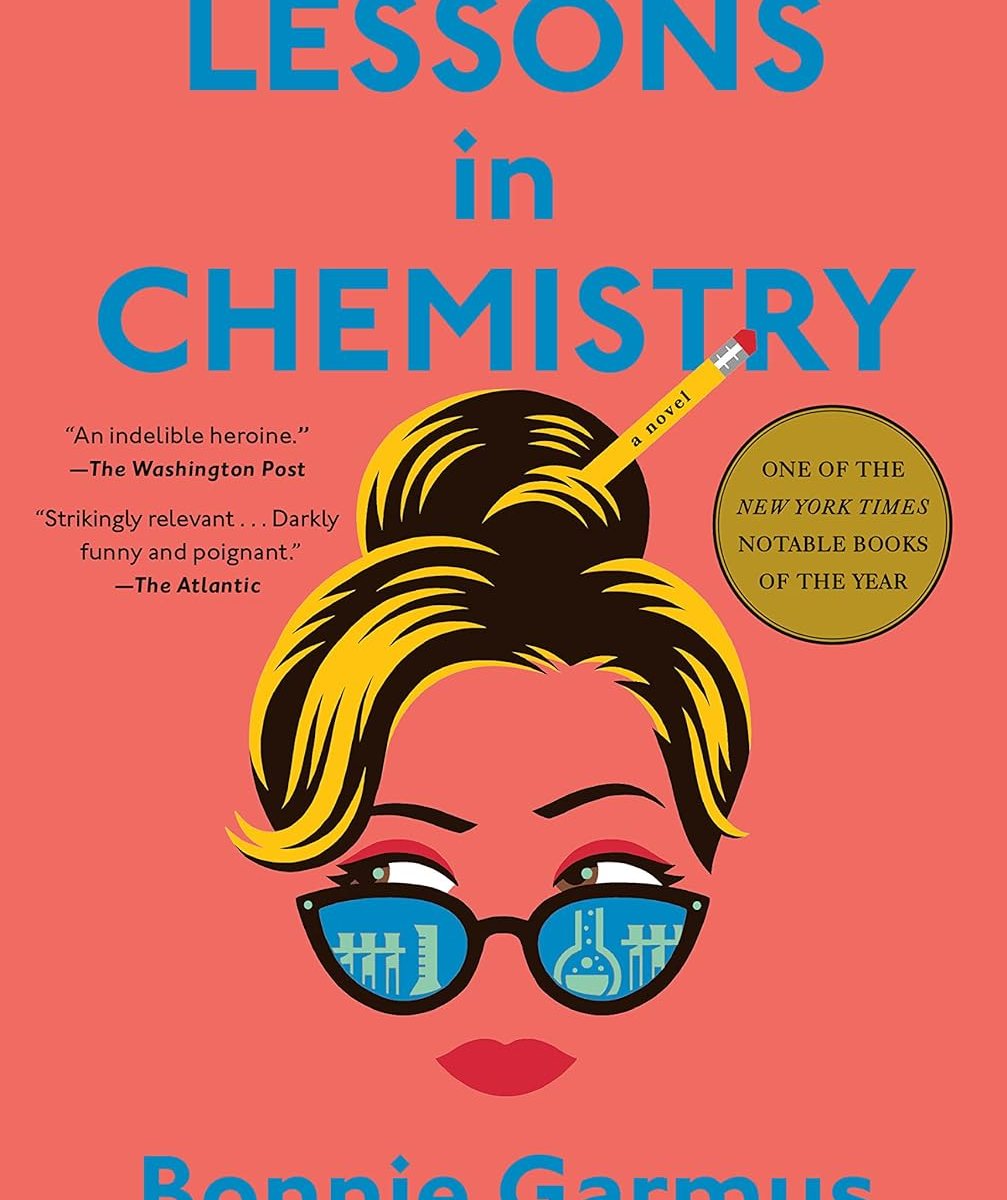
Bonnie Garmus’ novel Lessons in Chemistry tells the story of a confident, young female chemist named Elizabeth Zott. The book primarily takes place in the early 1960s but also slowly reveals the characters’ pasts throughout. Lessons in Chemistry has become popular since its release in early 2022. A year after it came out, the waitlist to borrow a copy of the audiobook from my local library was still over 4 months long! After listening to the novel, I understand why it’s been so successful. Lessons in Chemistry explores a range of topics such as feminism, faith, parenthood, what molds a person, and even what it means to be a human. It has romance, tragedy, humor, and whatever it is that makes you impatient to know what happens next.
When reading any book containing science themes, whether fiction or nonfiction, I am always curious about the characters’ faith and the worldview presented in the book. In real life, scientists hold a wide range of beliefs about spiritual things. (Research backs this! Check out Elaine Howard-Eklund’s work for details.) Many of them don’t publicize their beliefs simply because they want to “stay in their lane,” but every scientist is a person and every person has a belief system. Fictional characters are no different.
Plenty of others have reviewed the book, and I don’t feel a need to do that here. Rather, I’d like to share with you five claims that author Bonnie Garmus makes about religion within the pages of Lessons in Chemistry. If you haven’t read Lessons in Chemistry already, go read it! Apple TV+ is also releasing a miniseries adaptation, so if reading isn’t your thing, soon you can watch instead. The rest of this post assumes that you know the characters and storyline, so while it doesn’t intentionally contain spoilers… beware!
Science disproves the need for God
Main characters Elizabeth Zott and Calvin Evans are both chemists with research interests in abiogenesis. As the book explains early on, abiogenesis is the idea that the very first life had to originate from a nonliving (abiotic) source. Note that this on its own does not at all reveal Elizabeth and Calvin’s atheism! A large number of Christians agree with the idea of abiogenesis and attribute it to part of God’s plan for creating life. However, in discussing the politics of funding abiogenesis research it becomes apparent that there is a concern the results “might show God isn’t real.” Mad Zott, of course developing her worldview from her mother, calls her kindergarten teacher out for saying that God created the world (chapter 27). It seems clear that, consistent with their atheistic belief systems, Elizabeth, Calvin, and Mad believe that God is not needed to create the universe. If science can explain the origins of everything including life itself, why bother with God?
A lack of need for God is further supported in the backstory of Mr. Wakely. Wakely takes a chemistry class alongside his divinity school education to prepare for “defending against the enemy,” but only finds himself doubting his understanding of creationism the more he learns (chapter 28). While the book never outlines this explicitly, it is obvious that Wakely sees the creation debate as a war that necessitates picking sides: either God explains the origins of the universe, or science does. When he learns that one side doesn’t hold water, he is forced to swap sides (even if only internally).
The mistake all of these characters make is a very popular one often referred to as the “God-of-the-gaps” fallacy. When we don’t understand something, there is a temptation to explain it by saying “God did it.” In other words, God fills the gaps in our knowledge. This encourages the idea that when there is no gap, there is no need for God to fill it. When we understand something, we don’t tend to attribute it to God. As a Christian, I believe that God is involved in everything. We call this God’s sovereignty. But God’s involvement in something is completely independent of my–or anyone’s–understanding of that thing. Yes God created miraculously from nothing, but God also engineered the physical laws of the universe with the intention of bringing about more.
The Bible is mythology
Most of the information Lessons in Chemistry shares about the Bible comes from Calvin Evans in chapter 23. Calvin describes the Bible as an old document written by drunk people. He provides examples such as the burning bush to demonstrate that the stories are too ridiculous to have actually happened. Wakely the minister does not even attempt to rebut these claims.
Calvin’s view of the Bible reveals his naturalistic bias (which is consistent with an atheist character as well–to believe God does not exist requires a belief that anything supernatural is impossible). Because Calvin already believes miracles cannot happen, he must assume that the burning bush and every other miracle recorded in the Bible is fake. If the Bible is a book full of fake events, then either the authors intended to write fiction that was later mistaken as history, or the authors intended to write history and were out of their minds.
The problem with this claim is not its logic, but its premises. That miracles are impossible is an assumption, and it’s a philosophical one, not a scientific one. Because science can only study what is entirely natural, many jump to the conclusion that science-minded people must embrace naturalism. However, science just doesn’t have anything to say about the supernatural. Scientists don’t need to be naturalists, and the majority are not (again, see Elaine Howard-Eklund’s work). They just need to recognize science’s limits as they participate in it.
I won’t get into the evidence for the truth of the Bible here, but below are a few great resources on the topic:
- The Shortest Version: Is the Bible True? 5 Reasons Why the Answer is Yes
- Is The Bible True? The Cumulative Case For The Reliability Of The Gospels –J. Warner Wallace
- Are There Archeological Scientific Discoveries That Affirm the Bible’s Historical Accuracy? –Hugh Ross
- Fulfilled Prophecy: Evidence for the Reliability of the Bible –Hugh Ross
- The Long Version: I Don’t Have Enough Faith to Be An Atheist, chapters 11 and 14 –Norman Geisler and Frank Turek
Religious people are not genuine
Every major character who believes in God contributes to this point. If these characters represent religion, I would agree. Like any group, there are bad apples who do use God, Christianity, and/or the Bible as a manipulation tactic. As a whole, there is no grand conspiracy among theists to deceive the world for selfish gain. If anything, Christianity encourages the pursuit of truth and teaches that every human being is to be treated well, and with respect.
Early in the book, Elizabeth describes her parents’ entrepreneurship: they travel as “evangelists” warning people of the coming destruction, proving themselves by performing “miracles,” and offering salvation for sale. They pack up and run with the cash before anyone can realize that the end is not actually coming.
It is clear that the clergy responsible for running All Saints Boys’ Home were massively corrupt, and it is implied that they abused Calvin during his stay there as a child.
The neighbor and babysitter Mrs. Harriet is an overall morally upright character–not a criminal like the others–but even she doesn’t seem to have any conviction that her Catholic religion is based on truth. For her, it’s wishful thinking.
Finally, Mr. Wakely, the minister himself, a representative of faith, doesn’t believe the majority of Christianity is true. He admits that ministers have to “lie often” in their jobs, particularly while comforting people (chapter 28).
And of course, the chronic lies of “religious people” within the pages of Lessons in Chemistry imply that religion itself is a lie. So if religion isn’t real, then what is it for?
Religion only exists to comfort and control people
I have to admit that this one bothered me the most. It is an idea deeply woven into the book that comes up many, many times. And it’s garbage.
Every time Mr. Wakely “defends” faith, he turns to what people need to feel better or to behave morally. He never turns to truth, and he even describes lying to people as a necessary part of his job as a minister (chapter 28). He says that instead of science, he needed ways to tell people to behave (chapter 28). When Elizabeth claims that people think the Bible is “normal,” Wakely proposes that the Bible is anything but normal! However, rather than describing the Bible as divine truth… he suggests that “normal” isn’t what people want to read (chapter 40). The Bible is all about what people want to hear.
Wakely is the worst offender, but not the only one. In a discussion with Mad, Mrs. Harriet defends theism by explaining that people have to believe in God if they want to believe in heaven or hell (chapter 27). Obviously believing that heaven is real can be comforting. Mrs. Harriet is uniquely comforted by hell’s existence… because she thinks her awful husband will end up there. So once again, the reason to believe that God exists has nothing to do with the evidence that God actually does exist and everything to do with the hopes and desires of people. It’s more wishful thinking.
Lessons in Chemistry typically uses the word “religion” rather than specifying any belief system, but it is apparent from the details that the book is critical of Christianity in particular. Christianity does not exist to comfort or control people. Christianity exists because there is evidence that its doctrines are true. Its primary message is a comforting one to those who recognize the trouble they are in: that God had mercy on us and made a way for our evil to be wiped away. But the comfort of the gospel doesn’t come without many other discomforts (Matthew 16:24-26; Luke 14:25-34), which are only worth enduring if Jesus really was God in the flesh and if he really did die and rise from the dead. Christianity is also very far from trying to “control” people’s behavior. In fact, it teaches that behavior modification on its own never lasts because no law will ever be capable of changing evil hearts into good ones (really the entire Bible points to this, but for time’s sake, you can look at Hebrews 8:6-7, 10:1-18).
Again, there is far from enough room to provide all the evidence for the truth of Christianity, but here are some places to start:
- Short: Why I Am a Christian (Even Though I Don’t Believe in Santa Claus, the Easter Bunny, or the Tooth Fairy) –James Choi
- Shorter: 10 Concise Pieces of Evidence for the Resurrection –George Sinclair
- Long: The Case for Christ –Lee Strobel
- Longer: I Don’t Have Enough Faith to Be an Atheist –Norman Geisler and Frank Turek
In addition to comforting people in times of loss and uncertainty, Elizabeth proposes that religion comforts people in their guilt. In an interview, she preaches that religion provides us with excuses to sit back and do nothing about the bad things in the world, whereas humanism holds us responsible for our atrocities (chapter 37). In other words, we are to blame and it’s up to us to fix it.
Surely some people assume that “God will fix it” to keep themselves content in inaction, but broadly speaking, this isn’t consistent with Christianity. Yes, Christians petition God for positive change, but the Bible teaches that God uses human beings to enact his will (Romans 12; Ephesians 2:10; 2 Corinthians 5:20). It holds people accountable for the way they treat others, Jesus himself famously delivering the “Golden Rule” (Matthew 7:12; Luke 6:31). It encourages us to care for the widow and the orphan, to conduct fair business, to pursue peace and justice (Exodus 22:22; Deuteronomy 25:213; Isaiah 1:17; Zechariah 7:9-10; Titus 3:14; Hebrews 13; James 1:27). According to the Bible, God fully expects us to participate in addressing present evil and suffering even while he promises to one day bring an end to all evil and suffering.
Faith is independent from religion
I’ve spent a number of words now addressing Lessons in Chemistry‘s “lessons” about religion that I believe to be false. This last one, though, is one that I agree with.
In conversation with Mr. Wakely, Madeline expresses that she doesn’t have hope, she has faith. Mr. Wakely finds this word choice odd, and Mad defends it by saying, “you realize that faith isn’t based on religion, right?” And that question concludes chapter 34.
Wow! Despite the fact that Mad is supposedly four years old, maybe up to five by this time in the book, this observation demonstrates a more thorough philosophical understanding of faith than most (adult) popular atheists do. Famous atheists such as Richard Dawkins, Victor Stenger, and Carl Sagan often redefine “faith” as the belief in something with no evidence or even in spite of evidence to the contrary, then distance themselves from it. They would never say they have faith… But Madeline does. She must define it differently.
The act of faith, in a nutshell, is trust. It involves believing something based on authority, as opposed to entirely understanding it with the logic of your own mind. Faith is not separate from reason, though. We use reason to decide whether an authority is trustworthy. (I’m planning a new Define Your Terms post all about faith in the near future! So follow me on Instagram @science.magnifies to know when it’s released!)
Everyone has faith of some kind. No one can know everything by pure reason alone. For example, I have faith that Einstein’s theory of general relativity accurately describes the universe. While I may technically hold the capacity to learn physics, I can’t do so entirely empirically and reason my way to this theory myself. But there is reason for me to trust that Einstein and all of the physicists testing his ideas are reporting true data and true interpretations. I hope this example demonstrates that faith does not require religion, just a brain.
The religion of Christianity certainly asks people to have faith in what God has revealed about himself, but it actually doesn’t ask us to take the facts of God’s existence or the legitimacy of the Bible on faith alone (refer back to the resources I’ve linked in previous sections). So what is religion then? Emile Durkheim defines religion as “whatever system of practices unite a number of people into a single moral community.**” This definition leaves room for something many pastors and ministers (real ones, not Wakely) preach: you can be religious and have no faith at all. You can follow all the practices and yet trust nothing of what God says. Many, many, many Christians hold faith to be drastically more important than religion–what we may refer to as “works”–for this reason. “For by grace you have been saved through faith. And this is not your own doing; it is the gift of God, not a result of works, so that no one may boast” (Ephesians 2:8-9, ESV).
**Stanford Encyclopedia of Philosophy: The Concept of Religion (https://plato.stanford.edu/entries/concept-religion/)
 Science Magnifies