Words can take on different connotations and even meanings in different spaces. Right now, you and I have the ability to communicate with each other because we have agreed that certain words have certain meanings. When I say, “cloud,” you know that I am talking about a white or grey, fluffy-looking mass of water vapor up in the sky. But what happens when we don’t agree on the meaning of a word? We can’t communicate. We might fight, become confused, and feel unheard or misunderstood. We are limited in our ability to hold a discussion, to debate well, and to solve problems together.
This happens a lot at the intersection of science and faith and in many cases, we may not even be aware of our clashing definitions. If I told you to look at a “cloud” shaped like a turtle, but I didn’t mean “a white or grey fluffy-looking mass of water vapor in the sky,” you might search for a turtle-shaped white or grey fluffy-looking mass of water vapor in the sky for quite a long time before giving up… then never know that I was actually trying to bring something else to your attention. How would you ever know? You’ve always thought “cloud” meant “white or grey fluffy-looking mass of water vapor in the sky” and have no reason to think I may have meant anything else by the word.
In this series, I would like to survey key terms that pop up in science-faith discussions and wreak havoc. Defining our terms allows us to communicate, which in turn, allows us to discuss, debate, and solve problems together again.
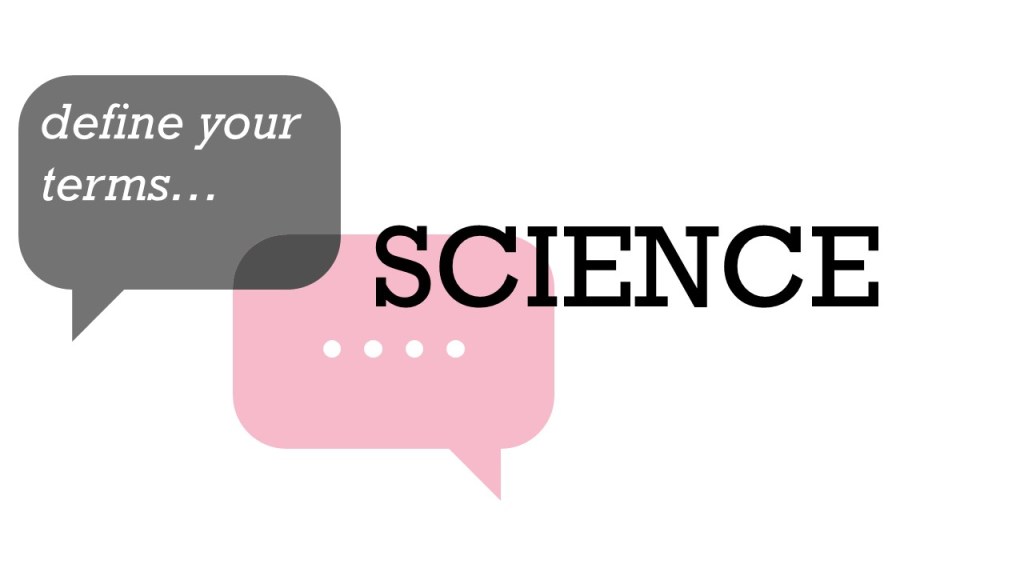
term 3 : SCIENCE
If you Google, “define science,” you will find this definition from Oxford Languages:
“the systematic study of the structure and behavior of the physical and natural world through observation, experimentation, and the testing of theories against the evidence obtained.”
A few terms within this definition stand out that help us distinguish “science” from other forms of knowledge. Science is systematic, not arbitrary. Science studies the physical and natural world, not the supernatural. Science uses testing, and evidence to draw conclusions, not abstract philosophy or feelings. If it isn’t systematic, if it makes claims beyond the physical world, or if it is void of testing and evidence, then it isn’t science.
*Please note that this definition of “science” is relatively modern, so if you frequent older writings (like pre-1900s), you may come across “science” used simply as a synonym for “knowledge.”*
Science is from God and for God
As a Christian, I acknowledge science as an intellectual activity that utilizes God-given capacities to explore and describe the patterns of God-created things. Science is a gift from God! God provided the senses we use to make observations, and the logic required to design an experiment or interpret evidence. Thank you, God, for my senses and logic! And this gift is one that keeps on giving through its applications to technology and medicine and conservation and so much more. Timothy Keller identified scientific advancement as a common grace1 (that is, a blessing God gives to the whole world), and I agree with him.
Not only does science serve as a gift from God, it also glorifies God. Whether an artist, writer, engineer, or builder, any creator enjoys when others demonstrate interest in their work. Interest indicates appreciation! The level of interest required to scientifically study the things God has made demonstrates that God’s creation holds great value. As understanding of the things God has made grows and deepens, more of God’s perfect design is revealed. We discover even more intricacy, detail, and even beauty in nature that brings God further glory.
So if science is something from God and for God, why do some Christians have such passionate (and negative) feelings about it?
More than just “science”
Scientists and science enthusiasts in the public eye can be guilty of stepping beyond science into philosophy. Recall that science is defined in part by its scope: the physical or natural world. Defining and describing “science” is not even within the realm of science, but rather “philosophy of science.” When someone claims that scientific data answers questions about the supernatural (for example, whether or not God exists), they have overstepped the inherent limits of science. Popular advocates for atheism may be the most guilty of this, so for some Christians, science’s association with atheism gives it a bad taste.
In light of the tension, in addition to defining what science is, I would like to address what science is not.
Science is not a set of facts.
Science is an activity. This means that no individual “fact” (yes, even the law of gravity) is
“science.” Further, this means that a person can hold a high view of science without subscribing to every single “fact” reported by it. Truth be told, most active scientists don’t even agree with every claim published in their journals. Scientific claims are up for debate, and part of a scientist’s job is to debate them based on the evidence available.
Science is not naturalism or materialism.
Though science is limited in scope to natural things and some call this “functional naturalism,” naturalism does not equal “science.” This is an equivocation fallacy. Naturalism comes with its own assumptions that are not scientifically based, but are philosophical, claiming that natural causes are the only causes that exist. Functional naturalism is simply the practice of limiting interpretation to only natural causes. Functional naturalism doesn’t make any claims about the types of causes that can exist. Since science and naturalism are not the same thing, the debate really isn’t “science vs. Christianity.” It’s actually “naturalism vs. Christianity.” Let’s not call it “science” when we really mean “naturalism.”
Science is not scientism.
Weak scientism can be defined as “a matter of putting too high a value on natural science in comparison with other branches of learning or culture.”2 Extreme scientism posits that science is the only way of attaining knowledge.3 Clearly, utilizing one method does not exclude other methods from being useful or existing altogether. And ironically, scientism is self-refuting since its central claim cannot be established from science. Thus, scientism is both not science and also embarrassingly bad reasoning.
Physicist Ian Hutchinson puts it this way:
“The health of science is in fact jeopardized by scientism, not promoted by it. At the very least, scientism provokes a defensive, immunological, aggressive response from other intellectual communities, in return for its own arrogance and intellectual bullyism. It taints science itself by association.”
So to conclude, science is a systematic way of learning about nature based on observation and controlled testing. It cannot study God, only his creation. It does not make philosophical claims, and scientists who make such claims are stepping beyond the limits of science. I pray that defining our terms when discussing science and faith will help alleviate some of the unnecessary tension and frustration that come with these loaded terms. Let’s talk about science for what it is, not for the various baggage that has been added to it. And let us rejoice in the creator of all things–science included–as we do it!
- Timothy Keller, Rediscovering Jonah (p. 40)
- Sorell, Tom. Scientism: Philosophy and the Infatuation with Science. New York: Routledge, 1991.
- Hutchinson, Ian. Monopolizing Knowledge: A Scientist Refutes Religion-Denying, Reason-Destroying Scientism. Belmont, MA: Fias Publishing, 2011.
More resources:
The Limits of Science: https://undsci.berkeley.edu/understanding-science-101/what-is-science/science-has-limits-a-few-things-that-science-does-not-do/
Scientism: https://sciencereligiondialogue.org/resources/what-is-scientism/
 Science Magnifies