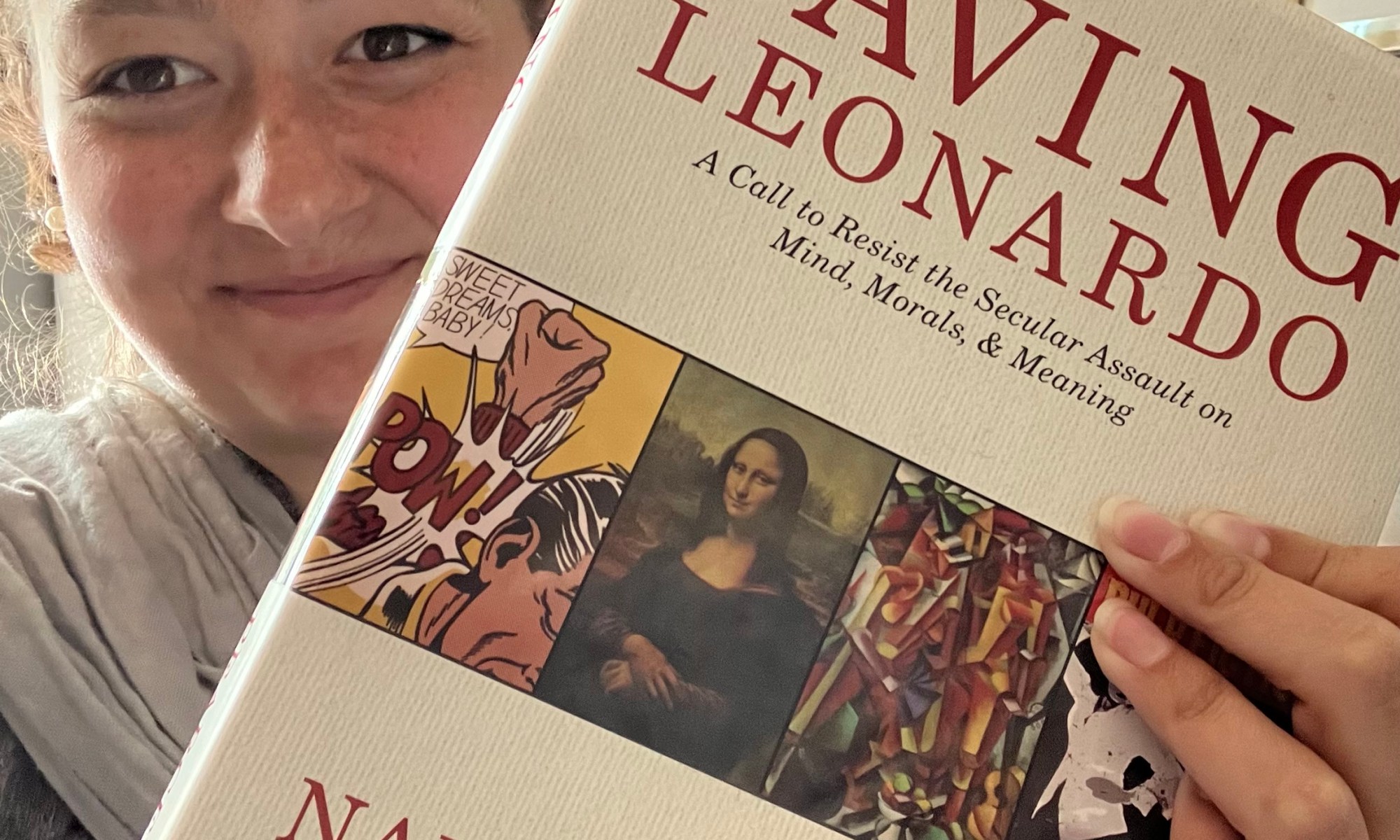
Have you found yourself witnessing a battle between “religious people” and secular ideas wondering… “How did we get here?”
Or maybe you’ve noticed that some people (most people) have a confusing ability to hold two incompatible views simultaneously so long as they stay in different mental boxes?
Both of these have their roots in the sacred-secular split, the topic of Nancy Pearcey’s book, Saving Leonardo.
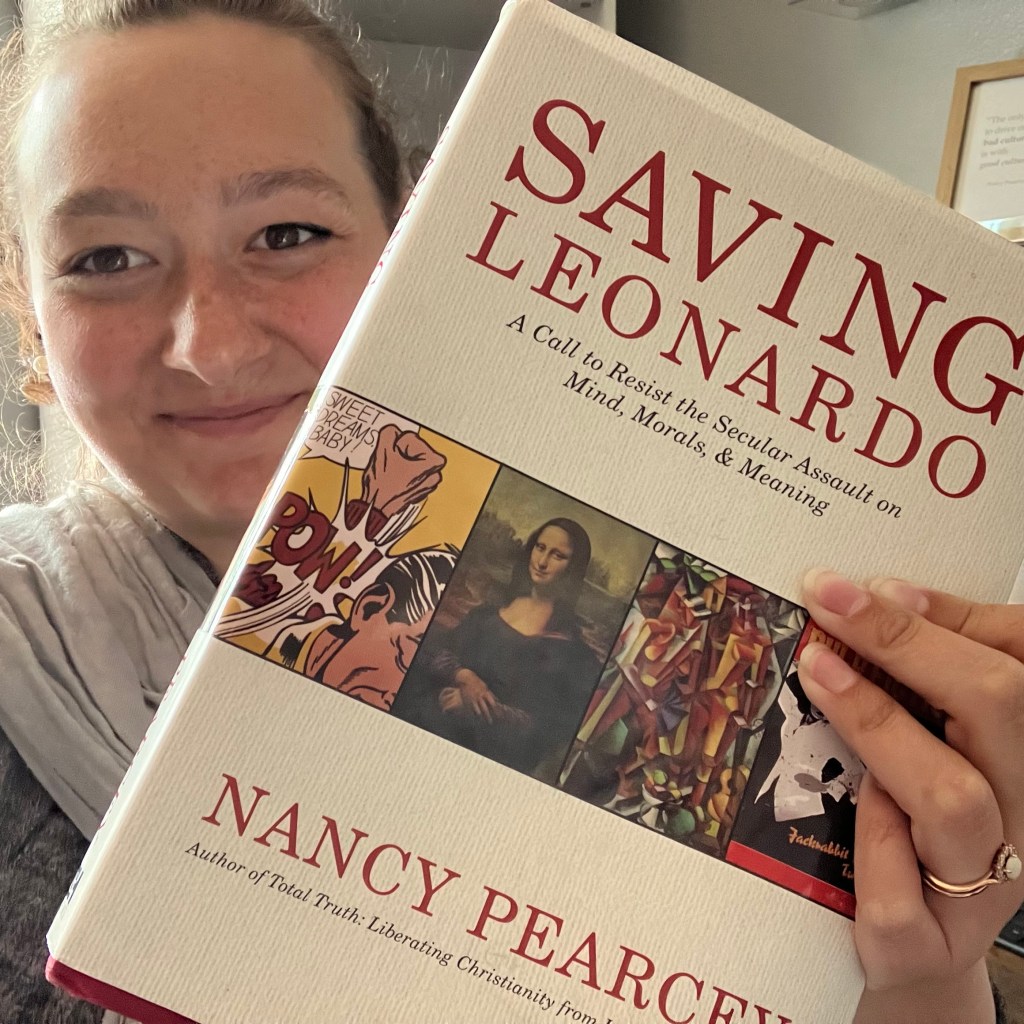
Nancy Pearcey is a Christian academic who has written extensively in apologetics, particularly relating Christianity to philosophies both past and present. In Saving Leonardo, Pearcey gives a tour of art history (visual arts, but also music and literature) and “reads” the philosophies exhibited by various artistic movements, teaching readers how to do the same. Pearcey demonstrates how the same philosophical concept–the fact-value split–has persisted through different eras of thought from the Enlightenment to today. Of course, new ideas have come about since then, but many are simply a re-branded version of the fact-value split applied to a new situation. Most importantly, she discusses the split’s influence on present secular thinking and how Christians are called to relate to it.
I personally found this read super interesting in regards to the science-faith debate, where science claims the “fact” realm and faith is designated to the “value” realm. The book does not claim to discuss science-faith issues nor did I pick it up for that reason. I was just pleasantly surprised to find that it spoke to how we think about those issues!
After going through the history of Galileo and the catholic church, Pearcey writes,
“The Galileo saga is typically told as a conflict between science and religion. But in reality, it was a conflict among Christians over the correct philosophy of nature.” (emphasis mine)
In how many other areas might we think we are fighting between one set of ideas when we’re actually debating philosophy without realizing it?
The most beneficial insights Pearcey provides in Saving Leonardo surround identifying the origins of the culture wars against modern Christianity in America and training readers to engage the culture without being shaped by it. She brings the problem to the forefront, Pearcey writes, “Traditionally, churches have responded to fortresses not by demolishing them but by building counter-fortresses–with thick, high walls to shut out the world. They adopted an isolationist strategy to shield people from false ideas.”
Yet, knowing where an enemy comes from is incredibly helpful in opposing him effectively. Looking away does not make an enemy give up and vanish. We have to engage. Pearcey encourages her readers in this pursuit by affirming the freedom that comes from truth:
“Biblical truth is so rich and multi-dimensional that it can affirm what is true in every worldview, while at the same time critiquing its errors and transcending its limitations. In this way, Christianity makes possible the greatest intellectual and artistic freedom.” (emphasis mine)
For those thinking of picking up Saving Leonardo, I have one warning: it’s dense.
The physical book is actually so heavy due to the weight of the paper needed to print figures in color, but there is also just a lot of high-level information in this book. It’s good stuff, but be prepared to focus and engage with all of your attention (i.e. don’t read this book before bed when your brain is tired). Not everyone will be interested in all the details of every philosophical era Pearcey goes through, but the first four chapters and epilogue make the book worth picking up by anyone and everyone.
If you are interested in philosophy, worldviews, or evangelism, Saving Leonardo is a must-read. Academically-minded readers may benefit from the challenge: is your thinking, including about religion, actually “unbiased” or “scientific”? Or is it just a product of Enlightenment thinking? For Christians, this read will assist you in recognizing how your work can amplify a positive, Biblical worldview in your field.
Overall, if you’re ready to do some worthwhile thinking that is relevant to life right now, go find a copy of Saving Leonardo. I enjoyed the read; it’s so worth the brainpower.
 Science Magnifies
One Reply to “”