Thoughts from Eugenia Cheng’s Beyond Infinity
Historical Christianity holds that God is infinite in all ways. God is infinitely powerful, infinitely loving, and infinitely good. God has infinite knowledge, infinite wisdom, and infinite patience. God demonstrates infinite wrath against the sin that has marred his creation, and infinite grace towards those who put their faith in him.
God is infinite! … but what exactly does “infinite” mean? Never-ending? Unlimited? Goes on forever?
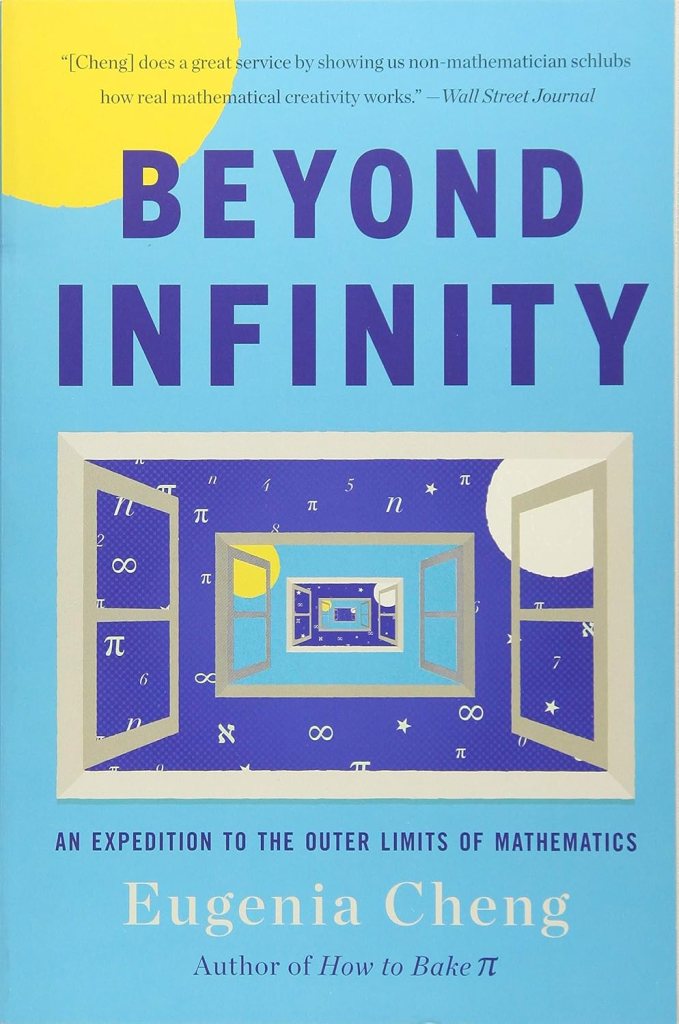
In Beyond Infinity, Cheng uses lots of thought experiments and pictures to explain what infinity is, what infinity isn’t, and what we know about how infinity behaves (at least mathematically). She did not write this book to describe God, but I picked it up from the library in an attempt to understand a bit more about what it means that God is infinite.
The Obvious
Oxford Languages provides this mathematical definition for infinity:
infinity (n): a number greater than any assignable quantity or countable number (symbol ∞)
Cheng’s discussion of infinity is mathematical, not philosophical or theological. Nevertheless, mathematical inquiry and experimentation can inform the concept of infinity that we bring to philosophy and theology.
Some things about infinity are apparent to basically everyone:
- Adding to infinity doesn’t make infinity bigger.
- Multiplying infinity by any positive whole number (e.g. 1, 2, 3) doesn’t make infinity bigger.
- Nothing can make a given infinity bigger than it already is.
If we were to translate these ideas into our concept of God, we would say that
- Adding anything to God doesn’t make God bigger.
- Multiplying God (if such a thing can be done) doesn’t make God bigger.
- Nothing can make God bigger than God already is.
Weird, Yet Logical
Early in her book, Cheng establishes that infinity is, well, weird. She writes, “Some weird things are like 1 = 0. Not just weird, but undesirable. So we try to build our mathematical ideas to avoid that. But other weird things don’t contradict the logic, they just contradict normal life. Those weird things don’t cause problems to our logic, they just cause problems to our imagination.”
In many ways, God is “weird” too. Yet, just like the mathematical concept of infinity, an infinite God may cause problems to our imagination, but not to our logic! The universe in which we live offers ample evidence for an infinite Creator and Sustainer. The existence of a universe bound by time, space, and matter points towards a cause unbound by time, space, or matter. That a finite universe would be made by an infinite God is incredibly logical! But trying to wrap our minds around the boundless, neverending, limitless God? Since our normal lives remain fixed in a bounded, ending, limited universe, our imagination just can’t keep up.
Countable Infinities?
One weird thing Cheng shares about infinities involves counting them. Of course, no one could ever actually count to the end of infinity, but some infinities can be called “countable,” while others are “uncountable.”
Countable infinities are sets that can be matched up with numbers. For example, the set of all whole numbers (1, 2, 3, 4, 5…). Now, you would never get to the end of counting a countable infinite set, but in theory, you could at least try.
Uncountable infinities are sets that cannot be matched up with numbers. For example, the set of all numbers. Even just between 0 and 1, there is always another unique number if we go another decimal place down (0.1, 0.11, 0.111, 0.111…).
Thinking this way, it is clear that God is uncountable. God’s power is uncountably infinite. God’s reach is uncountably infinite. God’s knowledge is uncountably infinite.
Cheng also describes another way that an infinity can be uncountable. “Not because there are too many of them, but because they’re too indistinguishable.” In other words, if you cannot tell the difference between things, you cannot count them.
This concept reminded me of the philosophical reason there can only be one infinite God. If God is a being infinite in all his ways, then any other entirely infinite beings would not be any different from him. They would be indistinguishable. With infinite power, reach, and knowledge, all truly infinite Gods do the exact same things, be in the exact same places, and make the exact same choices.
Incomprehensible and Indescribable
In addition to being impossible to count, infinity is also pretty much impossible to understand or describe. Despite having created words for a number with a hundred zeros (googol) and a googol zeros (googolplex), we limited humans reach an end to the numbers we can describe with words.
And we bump into the limit of numbers we can comprehend much sooner. Cheng notes that we don’t typically ever use numbers higher than “trillion” in real life (and even then, we don’t genuinely understand a trillion anyway). She asks, “How often do you need to refer to specific numbers bigger than 100,000 million billion trillion? I have certainly never needed to, except when engaging in exuberant hyperbole and referring to American University costing ‘a zillion dollars’ or perhaps ‘a gabillion dollars.'”
If we cannot comprehend a trillion, we certainly cannot comprehend infinity or an infinite God. We run out of words to talk about them, too. God’s infinitude is both incomprehensible and indescribable.
Where Knowable and Unknowable Meet
In his graciousness, though God is incomprehensible, God is also knowable. Even though no one could ever know everything about God, everyone could know some things about God.
Cheng concludes Beyond Infinity by linking infinity’s simultaneous knowable and unknowable qualities with beauty. As the concept of infinity shines with beauty, so God shines with an infinite beauty.
I will end with her words:
“So the sphere [of things we can logically explain] is always expanding, and as it does so, its surface keeps growing. The surface is where the explicable and inexplicable meet. The most beautiful things to me are the things just beyond that boundary of logic… I can get quite a long way towards explaining why a certain piece of music makes me cry, but after a certain point, there’s something my analysis can’t explain. The same goes for why looking at the sea makes me so ecstatic, or why love is so glorious… all beauty is right there on that boundary.”
May we all witness God’s weird yet logical, uncountable, incomprehensible, indescribable, knowable and unknowable beauty.
 Science Magnifies