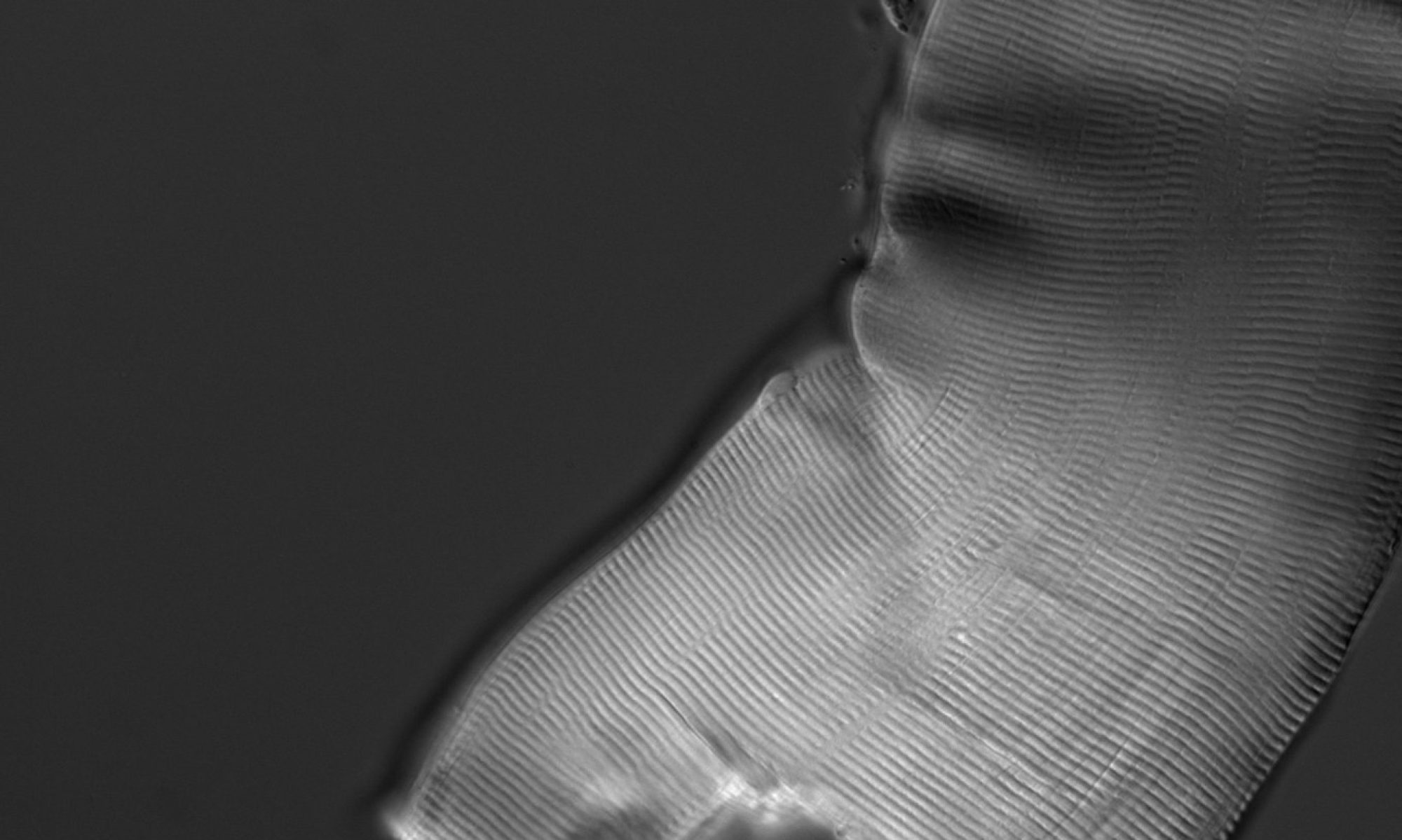

I spent three years of my life starting every research presentation with this fact: science has limits.
More specifically, what we can see under a microscope has limits. Magnification might overcome the limits of our bare eyes, but even with the best microscope that could ever be conceived, we will hit a limit to what we can see. Limits are not the microscope’s fault. Blame physical laws. Since vision is just light detection, and light has a finite size, vision cannot endlessly adapt to smaller and smaller sizes with bigger and bigger lenses. Like tracing pencil lines with a jumbo marker, at some point, everything starts to blend together.
The Limit of Resolution
In optics, the limit of resolution describes the point at which you lose the ability to distinguish things from each other. Light diffracts (bends) when it hits an object. Diffracted light waves then meet other light waves, and when they meet, they can combine into brighter light or they can cancel each other out, reducing brightness. This is why we don’t just see one big, even sheet of light everywhere; we see differences in brightness as a result of light diffracting off of stuff. But diffraction also introduces an inescapable limit to optical resolution. No matter what lens or hole you look through, light has a finite wavelength. At some point, the marker is just too fat to retain the detail of the dainty pencil drawings underneath.
We Hate Limits…
We wish we could live in a world free of limits. We complain when we bump into them and we do our best to scoot around them. To deny them. To overcome them. My own research aimed to overcome the diffraction limit of resolution in a new way, adding to a growing collection of “super-resolution” methods. Yet, studying the various approaches for overcoming the diffraction limit only emphasized this: no one is overcoming the limit at all. We don’t want to admit it, but super-resolution methods don’t let us see past the limit. They only work around the limit to process signals and build composite images that no eye and no camera could ever truly see. We may be collecting data despite the limit, but the limit to our vision cannot be overcome even with the fanciest microscope.
… But Limits Are Good for Us
God engineered light to be a certain way, and that certain way sets a limit on what can be made visible. Therefore, the limit of resolution is a product of God’s creative choices. If God creates with purpose and for good, which I believe he does, then this limit is purposeful and good.
A limit is purposeful and good? Limits don’t seem purposeful when they get in the way of our goals. Limits don’t seem good when they hinder our happiness, or at least the happiness we expect we would have if we could reach the unattainable. Yet God set these limits for his purposes, not for mine. He fashioned them to work towards his true definition of goodness, not for my feelings about what goodness is. I don’t like being told that my purposes and my idea of goodness rank any lower than of highest priority. And since limits remind me that I cannot do it all, have it all, or control it all, limits cause discomfort.
Discomfort, though, calls for attention. I notice the splinter in my finger because of pain that says, “Look here! Fix this!” Aware of my limits, I am positioned to notice the One who has none. Like a toddler trying to put on his shoes, when I recognize that I cannot do it, I am forced to turn to the One who can. Bumping into our limits turns us to God’s unlimitedness.
A Limitless God
We will never be able to see beyond 200 nanometers, but God can see every protein, virus, and atom. He needs no light to see, and he is not limited by the physical laws he wrote. His vision is infinite.
You can only gaze at infinity so long before you start to wonder at it. If God has no other reason for limits aside from pointing us to himself–our Creator and our Redeemer–then I am still satisfied with that single reason. An infinite God with infinite vision has no trouble seeing little me in this gigantic universe. He has directly observed everything I’ve ever done, said, or even thought, the moral and the immoral, the things worth flaunting and the things I’d rather keep secret. And in infinite love, he sent Christ to die for me anyway. God’s infinite grace easily covered my finite offenses.
May our limitations remind us of our beautiful, wonderful, limitless God!
 Science Magnifies