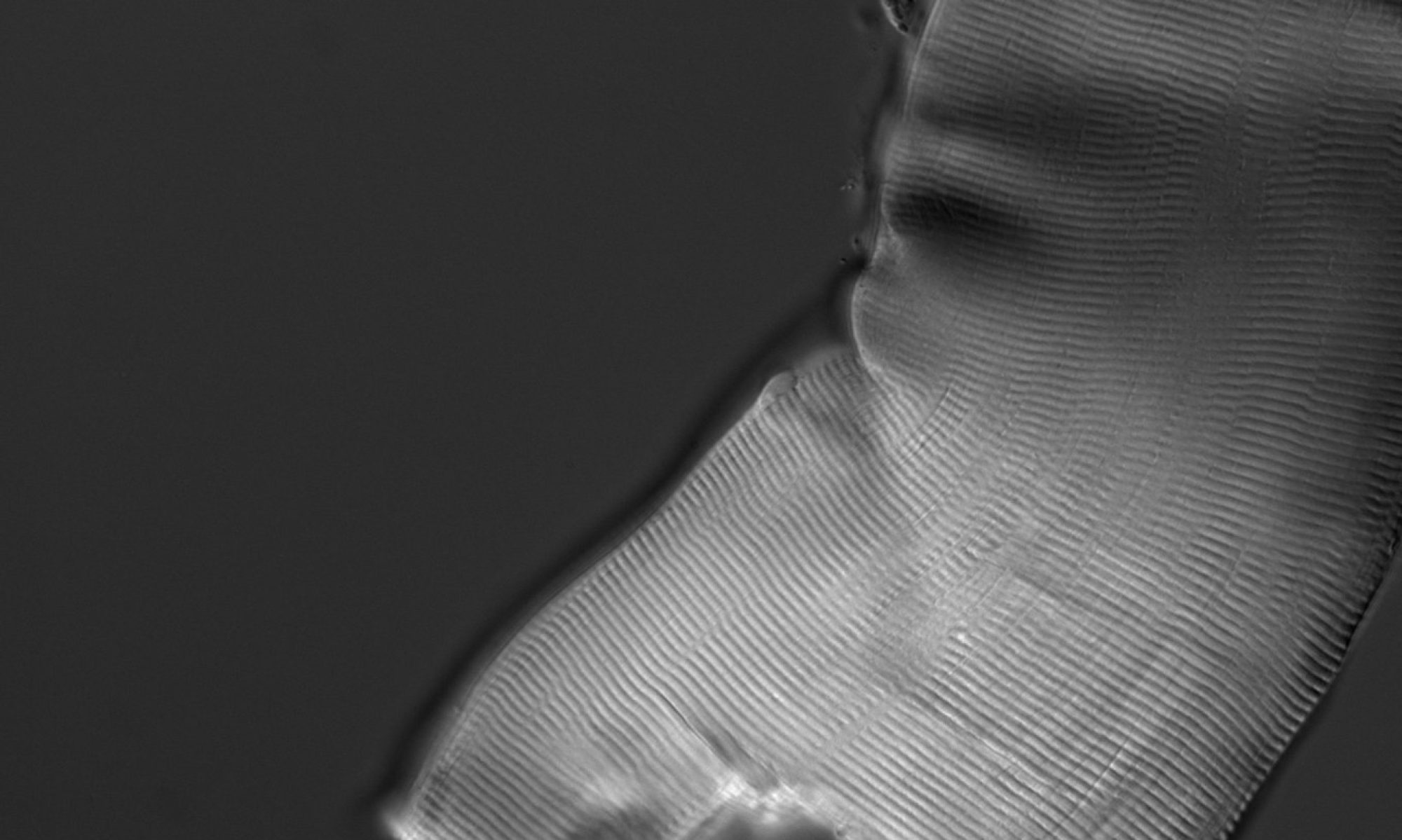
We live in an amazing world! When we dig into the details of nature, we find things that surprise us, make us curious, and often leave us bewildered. Even our best scientists only understand small pieces of the complexity of the world. I believe that there is a God who not only understands it all, but invented it all. And in my own scientific training, I have found that God thought of everything.
Have you ever considered that you and a steak are made up of the same stuff? That the same pieces that make up a chicken wing make up your body too? You probably know that steak and chicken wings are full of protein, and you probably also know that we need to eat protein to stay healthy. This is because the protein in our diets gives us the material to build our own proteins. Proteins are the molecules that perform most of the work in our bodies, so without them, our cells and bodies cannot do anything at all.
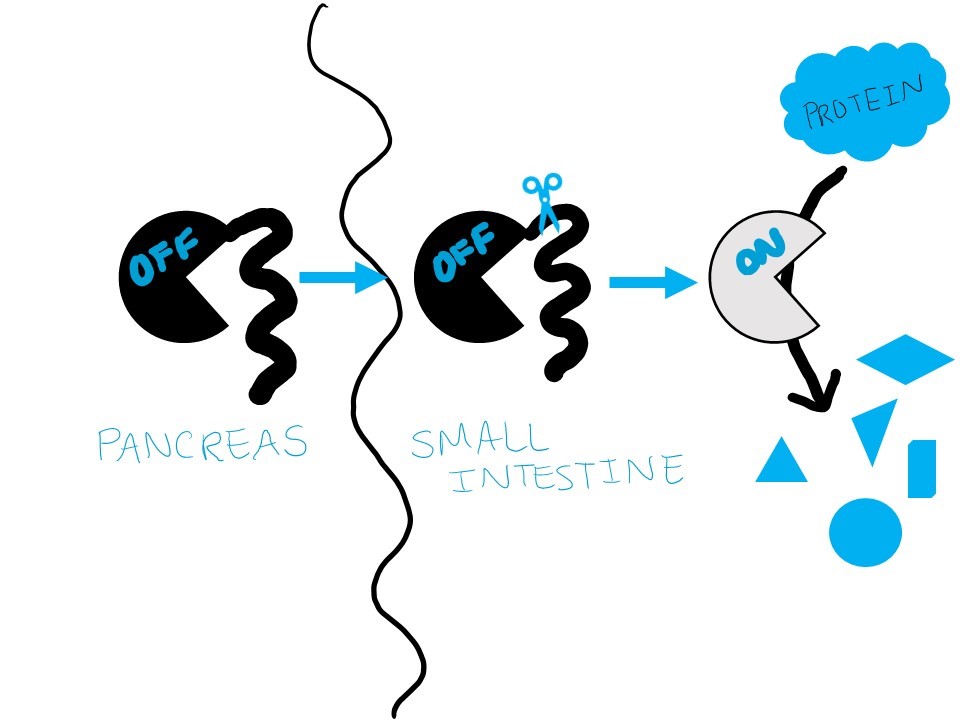
Before we can make our own proteins out of the ones that we eat, we need to break them down into pieces. To do this, we have special proteins called proteases that find other proteins and chop them up. Our pancreas makes proteases and then pushes them into our small intestine where they do their job.
That’s right: a protein cuts up other proteins. (I told you that proteins do most of the work!) And if proteases don’t find other types of proteins to cut, they will turn to cannibalism and cut other proteases instead. Proteases also cannot tell the difference between your proteins and your meal’s proteins, so proteases working in the wrong place can be a major problem. Luckily, God placed a control mechanism on our proteases so that they only work in the right locations!
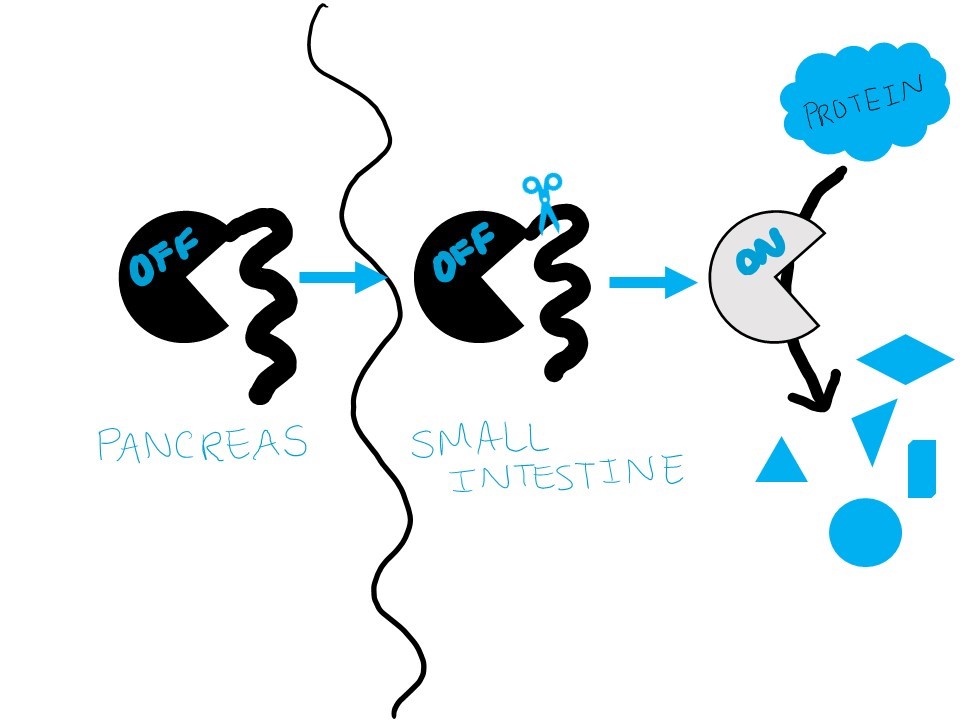
When our proteases are first made, they cannot cut anything. They have an extra piece that prevents them from doing their job (the protease with its extra piece is called an inactive precursor or a “zymogen.”) After the proteases arrive at the workplace–the small intestine–their extra pieces are removed. With those extra pieces out of the way, the newly arrived proteases are turned “on” and can get to work breaking down all of the proteins you ate.
That little extra piece attached to a protease is the reason that proteases do not cut up your pancreas or each other–it is why you do not digest yourself!* And if proteases somehow end up in another part of your body, their extra pieces will not be cut off and they will remain “off.”
Dear God, thank you for thinking of that one little extra piece when you designed our proteases. You are the cleverest of engineers and your foresight cannot be matched! We see your creation and we give you all the glory. Amen.
More about this topic:
*This is just one of several systems that work together to make sure your digestive system does not eat your own body–if you are interested in exploring some of the other systems, visit these resources:
- https://teachmephysiology.com/gastrointestinal-system/stomach/mucus-production/#:~:text=Gastric%20mucus%20is%20a%20gel,cells%20in%20the%20stomach%20wall.
- https://www.bbc.co.uk/bitesize/guides/zcr74qt/revision/5
- https://www.nature.com/scitable/topicpage/enzyme-catalysis-the-serine-proteases-nbsp-14398894/
Extra credit reading:
- Lowther, J., Robinson, M. W., Donnelly, S. M., Xu, W., Stack, C. M., Matthews, J. M., & Dalton, J. P. (2009). The importance of pH in regulating the function of the Fasciola hepatica cathepsin L1 cysteine protease. PLoS neglected tropical diseases, 3(1), e369. https://doi.org/10.1371/journal.pntd.0000369
- Verma, S., Dixit, R., & Pandey, K. C. (2016). Cysteine Proteases: Modes of Activation and Future Prospects as Pharmacological Targets. Frontiers in pharmacology, 7, 107. https://doi.org/10.3389/fphar.2016.00107
- Klein, T., Eckhard, U., Dufour, A., Solis, N., & Overall, C. M. (2017). Proteolytic Cleavage—Mechanisms, Function, and “Omic” Approaches for a Near-Ubiquitous Posttranslational Modification. Chemical Reviews, 118(3), 1137–1168. https://doi.org/10.1021/acs.chemrev.7b00120
 Science Magnifies