We live in an amazing world! When we dig into the details of nature, we find things that surprise us, make us curious, and often leave us bewildered. Even our best scientists only understand small pieces of the complexity of the world. I believe that there is a God who not only understands it all, but invented it all. And in my own scientific training, I have found that God thought of everything.
Since long before Jeff Bezos conceived of Amazon, and even before the very first postal service, complex logistics networks have been getting things where they need to go efficiently and economically. But these ancient, elegant systems don’t move plastic bubble mailers on trucks, or sort cardboard boxes in enormous distribution centers. Their fleets are microscopic, their cargo at the atomic scale. They operate within the living cells that make up you and me, and they make two-day shipping look entirely unremarkable.
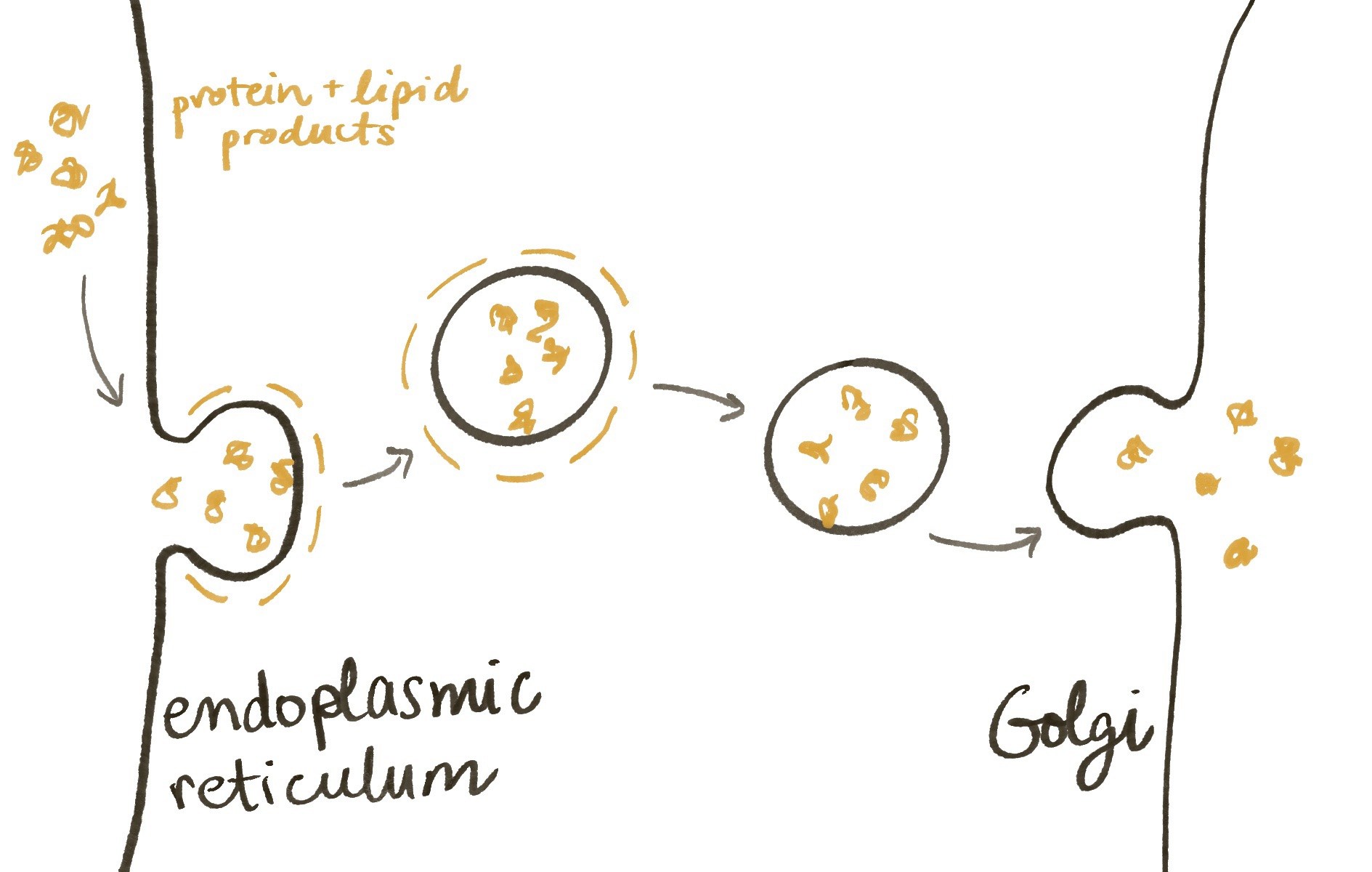
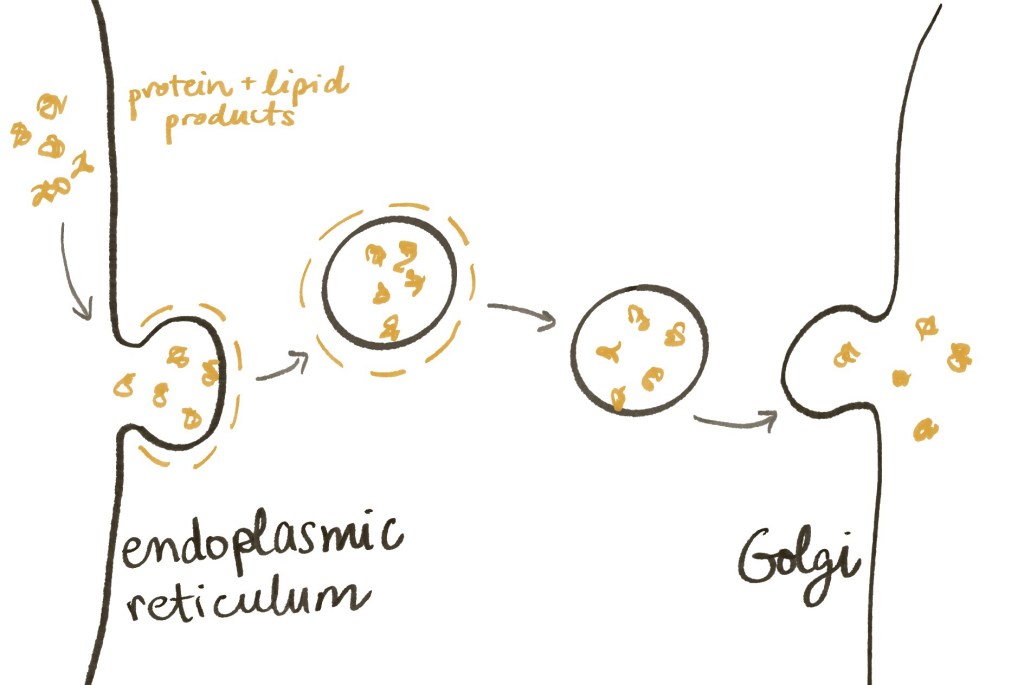
In the metropolis that is a living eukaryotic cell, the endoplasmic reticulum (ER) acts as a manufacturing hub for proteins and lipids, particularly ones that will be secreted out of the cell. Once these products undergo their initial construction, they are sent to another part of the cell, the Golgi, for some additional processing. To transport them, a series of other proteins work together to pinch off a part of the ER’s membrane and create a vesicle, which is essentially a bubble that surrounds the product and carries it to its destination. Once the vesicle has budded off entirely, proteins on the outside fall off, allowing the vesicle to merge into the Golgi’s membrane.
Now that the vesicle has joined the Golgi’s membrane, all its contents are dumped out. The protein and lipid products have reached their destination! But the exported products were not the only things inside the vesicle. Many other proteins from the ER (called “ER residents”) hitched a ride, and are now in the Golgi. Each of these perform irreplaceable tasks in bringing proteins to maturity, and in transport.
If this were the end of the road, the ER residents would be permanently stranded away from home, unable to resume any meaningful work. But there is a much better design.
Every ER resident carries identification: the sequence K-D-E-L (the amino acids lysine, aspartate, glutamine, and leucine, in that order). Specific receptor proteins in the Golgi recognize the KDEL sequence, and when they do, they signal a group of vesicle-building proteins to “build one here!” While similar in function to the ones in the ER, these vesicle-builders in the Golgi are entirely distinct. The vesicles they create only go one way to the ER, and proteins must have a KDEL ticket to ride.
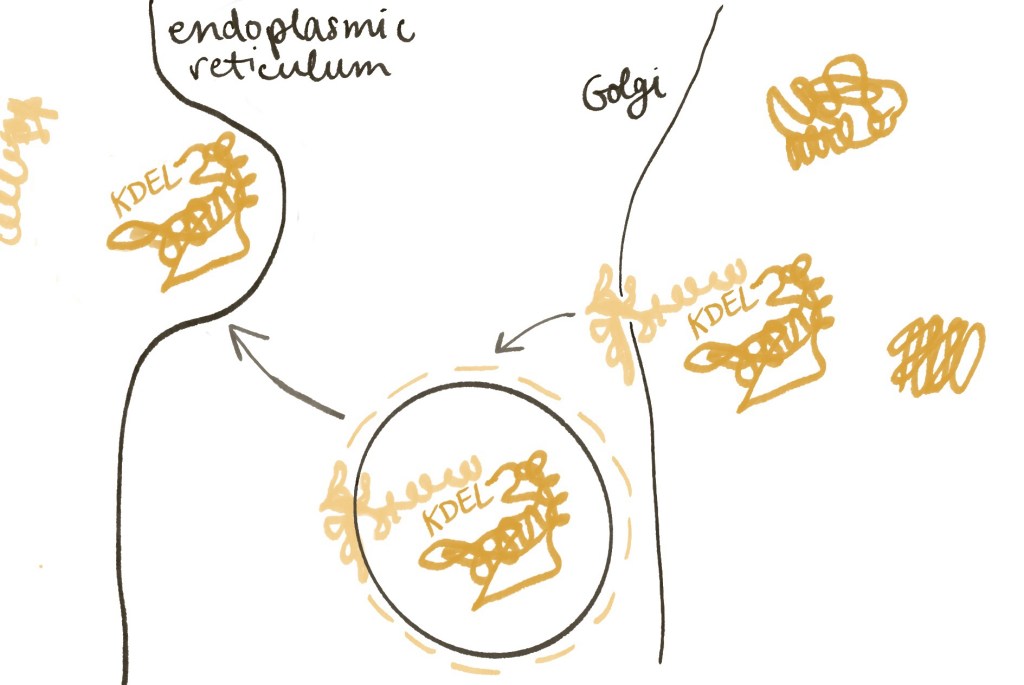
The return trip from the Golgi to the ER–called retrograde transport–is an elegant recycling system that allows the cell to use resources wisely and work efficiently. It prevents ER residents from clogging up the Golgi or being secreted as byproducts. It removes the need to build large quantities of new working proteins in the ER to make up for loss, saving considerable energy and materials. KDEL receptors make sure that retrograde transport operates exclusively, ensuring that Golgi residents or products meant for secretion aren’t needlessly sent away.
ER residents aren’t the only proteins carrying ID; each compartment of the cell has its own set of signal sequences (like KDEL) and receptors to make sure that each and every molecule gets where it needs to go. Signal sequences allow for extremely high levels of sorting. It costs lots of energy to fight entropy enough to maintain the order found in a living cell. Such detailed organization reflects the goodness and beauty of the cell’s Creator.
Creator God, thank you for thinking of every last detail of every single system that keeps life living. You’ve designed each protein with great care, providing it with all it needs to fulfill its purpose in the location you’ve placed it. Let the concern you have for the smallest molecules remind us of the concern you have for us. In Jesus’ name, Amen.
On Golgi-to-ER retrograde transport: https://www.youtube.com/watch?v=7pFCsSkczK0
Peter Watson, David J. Stephens; ER-to-Golgi transport: Form and formation of vesicular and tubular carriers. BBA–Molecular Cell Research 2005; 1744 (3): 304-315.
https://doi.org/10.1016/j.bbamcr.2005.03.003.
Natalia Gomez-Navarro, Elizabeth Miller; Protein sorting at the ER–Golgi interface. J Cell Biol 19 December 2016; 215 (6): 769–778. https://doi.org/10.1083/jcb.201610031

